Once a customer has paid for a holiday, the business looking after them takes on a responsibility that continues as the plans become real and, often, as they change.
That is the responsibility I want Constellation to help our customers carry. The data, recommendations and supplier infrastructure I described in the first two essays have to connect to the commercial and operational tools a holiday business needs throughout the journey, including the moments when a hotel declines or a family wants to change something they have already bought.
Our example remains the two adults and two children travelling from Delhi to Bangkok for three nights, then Pattaya for four, over 10–17 May. Following that holiday from quotation to service gives a fuller picture of why the product has drawn us into so many disciplines.
Supporting the sale from the first quotation
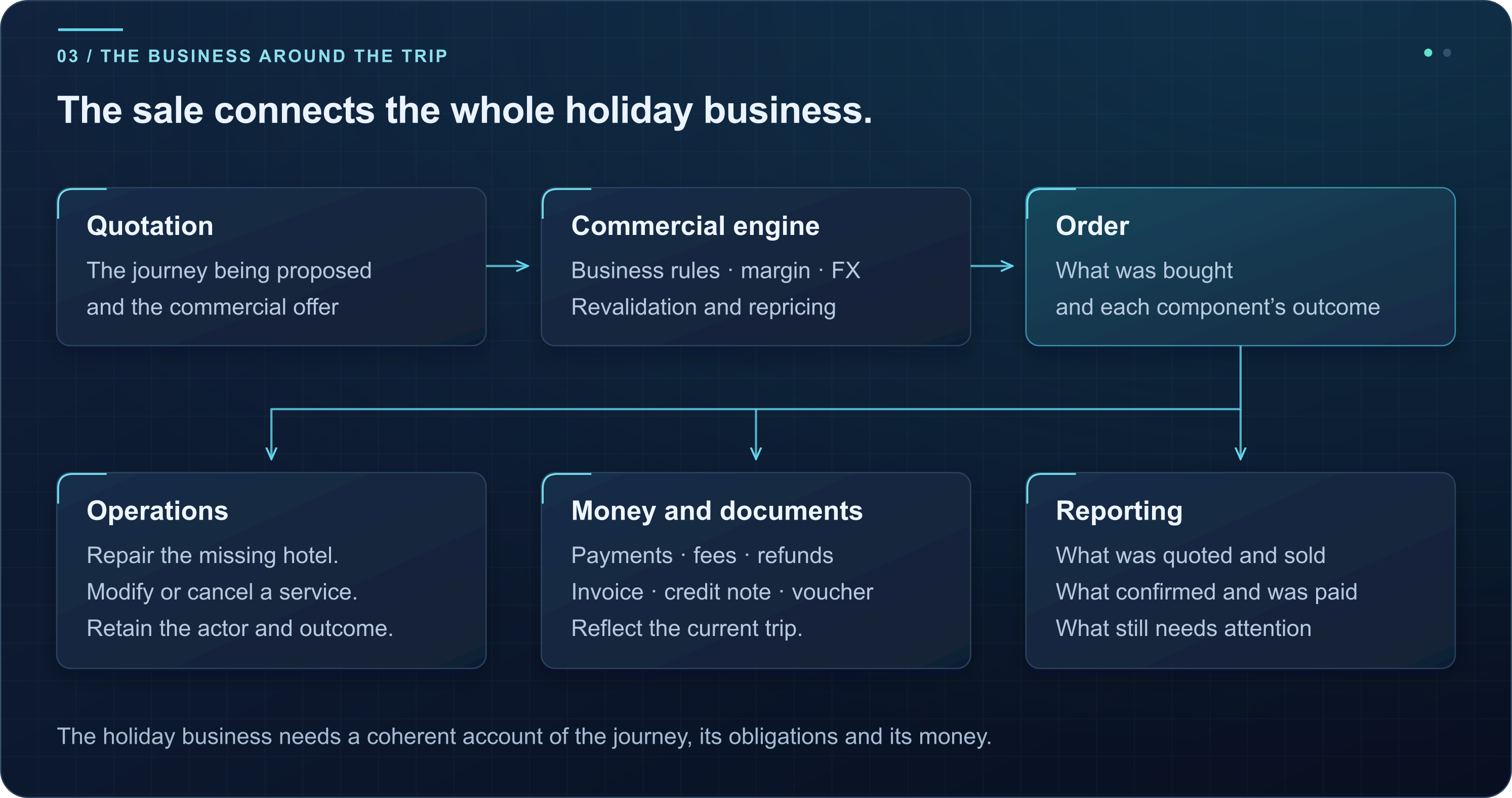
Well before payment, a customer may ask for a different Bangkok hotel, a lower-priced Pattaya option or an explanation of what the holiday includes. The business needs to respond while keeping track of the journey it has proposed and the commercial terms it is offering.
Our package can become a quotation in the CRM before anyone commits, and the proposed trip needs to remain connected to the order that follows. Underneath it, a pricing engine turns supplier net rates into sell prices using the business’s markups, commissions, currency conversion, payment fees, applicable taxes, discounts and cancellation terms.
A directly negotiated hotel can have different economics from a bedbank rate, and two holiday businesses may sell the same underlying inventory under different commercial rules. We have to preserve those distinctions through repricing and purchase so the business can understand both what it offered the customer and the economics of the sale.
Accounting for a purchase with mixed outcomes
When our example family pays, the Bangkok flight can ticket while the Bangkok hotel declines, even as the airport car and Pattaya services continue towards confirmation. Our booking path submits the city packages concurrently and also submits the components within each city concurrently, so a failed hotel does not stop the other purchases already in progress.
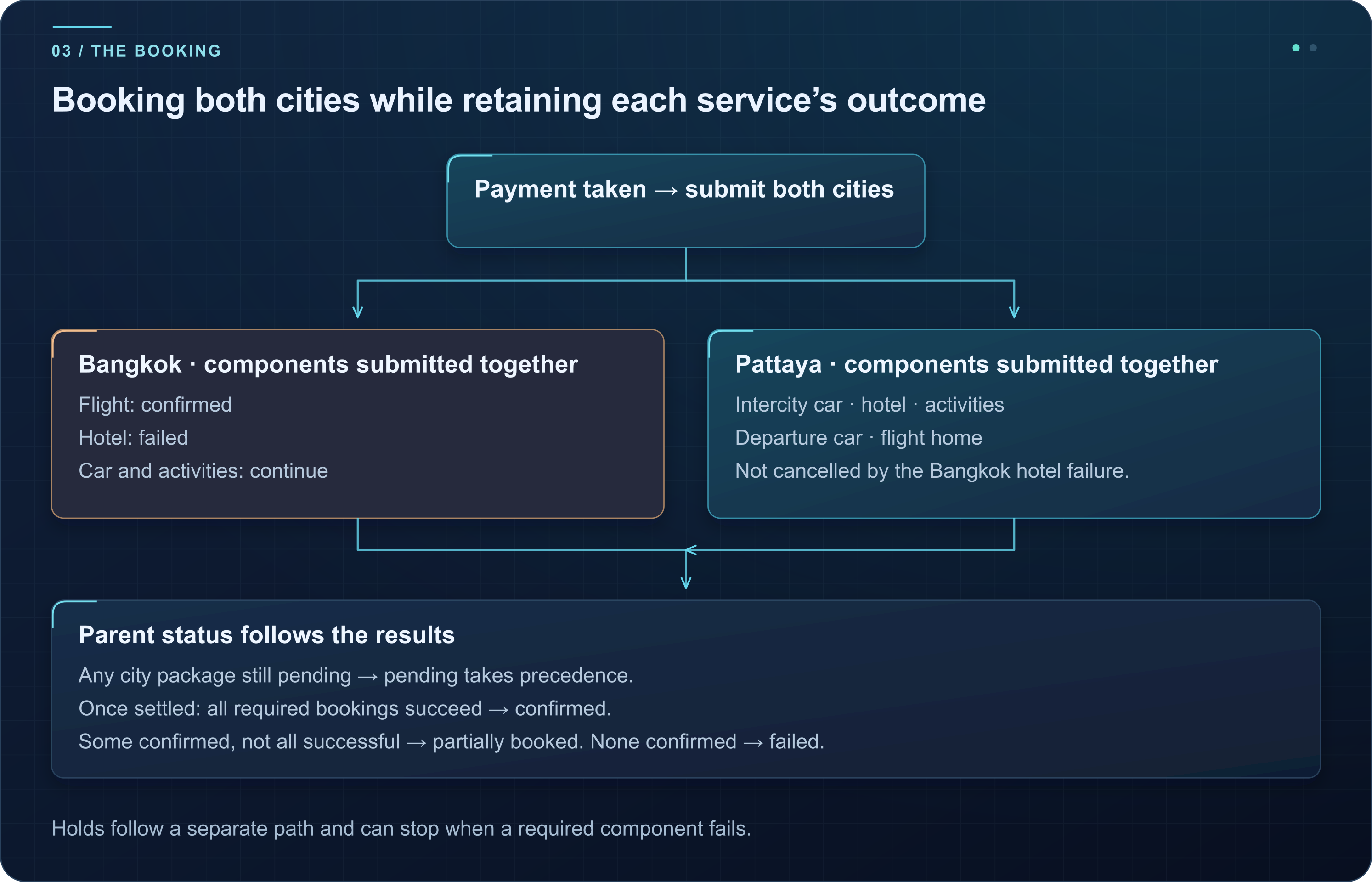
That choice means the business may have flights and a Pattaya stay confirmed while it still needs to replace the Bangkok hotel. The overall record must retain those commitments and make the outstanding work clear, which is why a partially booked trip is an explicit state we support.
Pending takes precedence while a city package remains unresolved. Once the outcomes settle, some confirmations without full success produce a partially booked status, while no confirmations and no pending outcome mean failure. A hold follows a separate path and can stop when a required piece fails; a booking preserves the work already under way across the components.
I regard those outcomes as situations a holiday business needs to be equipped to handle whenever several independent providers contribute to one purchase. The system has to make the next action understandable while keeping the confirmed services intact.
Giving operations a useful account of the order
To act on that trip, the team needs to see which services confirmed, which failed or remain pending, how much has been paid and whether the customer has a current voucher. Those facts can develop independently: a payment can be complete while a booking is partial, and a confirmed stay can exist even if its PDF was not generated successfully.
Keeping those distinctions allows the remedy to match the problem. Document generation can be retried without buying another hotel room, while an unresolved car reservation can be checked against its existing supplier reference. The order therefore retains the history and outcomes of each component so the team can work on the Bangkok hotel with a clear view of the services already in place.
This is a substantial operations product in its own right. The person servicing the holiday needs enough continuity and detail to understand what the customer has and what still needs attention.
Completing or changing a booked service
The failed Bangkok hotel can be addressed through a targeted rebook that reopens the relevant workflow, clears the declined inventory and cached attempt, and returns an agent to the same parent trip against fresh availability. The confirmed flights and Pattaya stay remain in place, with the completed action recording who handled it and closing the lead again.
Replacing an existing confirmed room introduces another ordering decision. Where the replacement needs to be secured before the original is released, we book the new component first and then cancel the old one, retaining both outcomes if either action needs further attention. A request to cancel just the Bangkok car similarly has to name that service, with an empty partial-cancel list rejected so the scope cannot be misunderstood.
These actions also carry fees, refunds and document changes. I want the product to make the scope and consequences clear to the person doing the work, particularly when the order already contains a mixture of confirmations and unfinished actions.
Maintaining one package as the holiday evolves
A fully confirmed holiday may still change because the family chooses another room, removes a car or receives a revised pickup time from a supplier. Those changes need to remain part of the same trip, with one current version that explains what the family has now, what is still being changed and how the package reached that point.
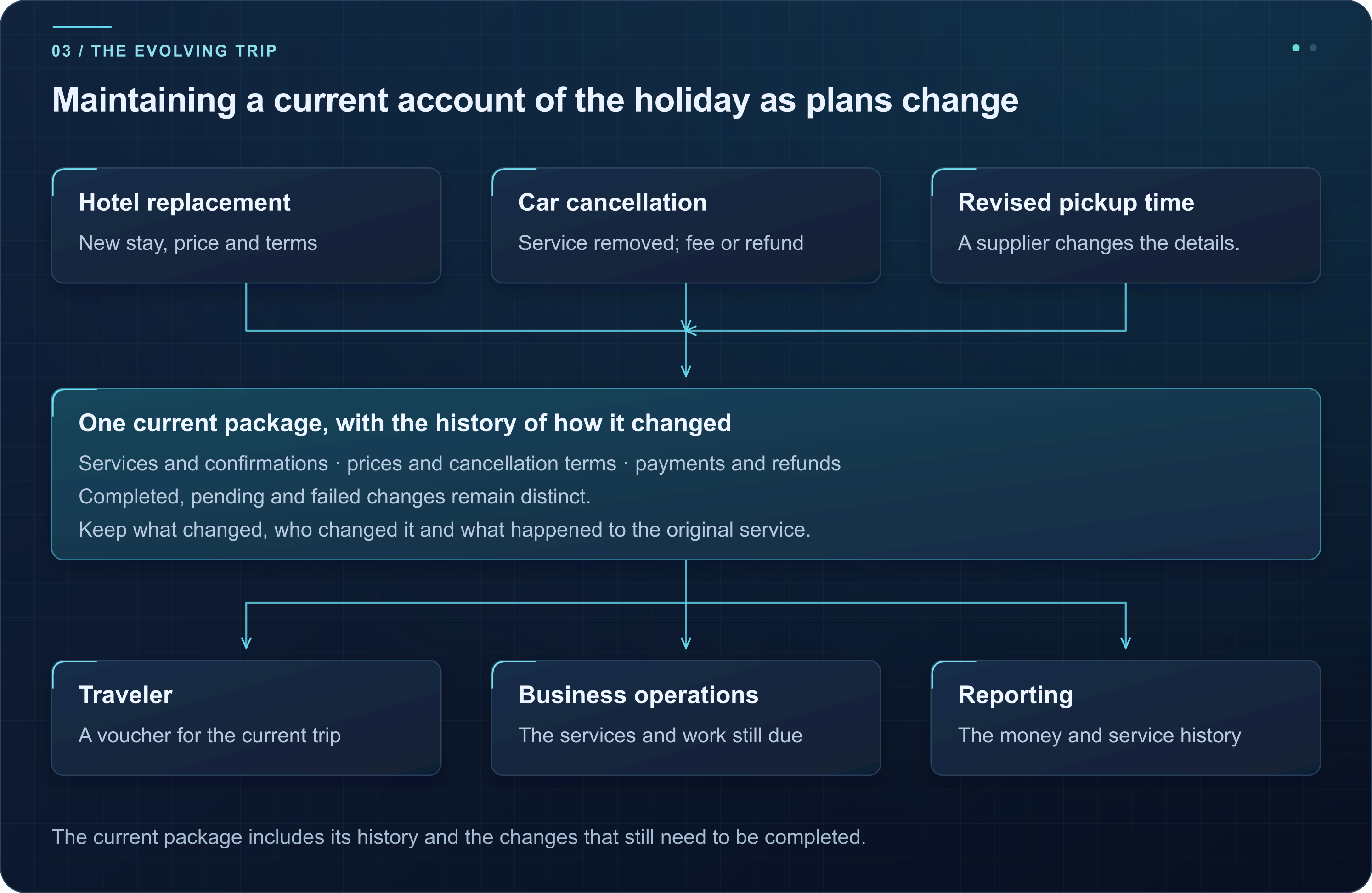
A Bangkok hotel replacement can bring a new confirmation, a different price and cancellation terms, and a new pickup address for the car. Any extra payment or refund belongs alongside those changes, while a replacement awaiting confirmation must remain visibly pending until the outcome is known.
Preserving the history is equally important. The team needs to know which stay was replaced, what happened to the original booking and who made the change; the customer needs a voucher describing the services available now; and reporting needs to account for the original transaction as well as the subsequent modification.
Changing the route itself requires separate care because moving the boundary between Bangkok and Pattaya can affect both stays, the drive and the activity plans. Keeping that distinct from a room replacement helps preserve the meaning of the whole package as the team services individual requests.
For me, this is an important part of what we are committing to build: enough continuity for the holiday business, the traveler and our own operations team to keep working from the same account of a journey that is still evolving.
Reporting on the business that actually happened
The reporting work follows from the same responsibility. To understand a sale, a holiday business needs to connect what was quoted and ordered with what suppliers confirmed, the payments received, subsequent cancellations and any money due back.
After this family’s car is cancelled and Bangkok hotel replaced, that means being able to see the current order, the original and replacement outcomes, the payment position, cancellation fees and the relevant documents. It also means keeping unresolved work visible, even when the overall value of the order appears healthy.
Bringing the commercial and operational views together reduces the need for someone to reconstruct the transaction manually from separate accounts. It is also a useful test of our own understanding: we should be able to explain both the services owed to the customer and the money associated with them as the trip changes.
Looking after the holiday after the sale
Supplier updates, pending cancellations and payment deadlines continue to arrive after booking, so the business needs workflows that keep the trip and the customer’s information current. A revised pickup time has to reach the confirmation and voucher, just as a cancelled car needs to be removed from the services the document says the family can use.
Invoices, credit notes and the record of who made a change all follow that same history. Document generation also needs a recovery path of its own, because a problem producing a file should not disrupt a service that has already been bought.
This is why Vista needs the current booking record after payment. Questions about whether the car is confirmed or still cancellable depend on the component’s actual status and terms, rather than the search result shown earlier. Where a person needs to act, the conversation has to connect to the operational work with the right context.
Why I believe this is worth building
What keeps me committed to this is the possibility of giving a holiday business the technology to carry its expertise through the entire journey, from the first idea and quotation to a change requested after everything was supposed to be settled. Our customers bring judgment, relationships and responsibility for the traveler, and I want the product to give that work a foundation on which they can offer more, serve people well and grow.
That ambition shapes the company we have to become. Maintaining dependable travel data, improving recommendations, running very different supplier systems and supporting the commercial and operational life of a booking each require sustained specialist work. I describe them as several startups within one company because we have to develop the depth of each while making their work come together for the same customer.
As a founder, I feel the responsibility in those choices. Every capability we add creates something we have to maintain, and a decision made in one part of the system can affect someone servicing a trip elsewhere. I want us to keep making those decisions with a clear view of the holiday business and the people it is looking after.
For me, the ambition behind Constellation is to give that business greater confidence in what it can create and deliver, while giving its customers confidence that the details of their journey will continue to hold together as their plans change. Our example family asked for seven nights in Thailand, and I want the care they receive across that week to reflect the depth of the work beneath it. Building a company capable of making that experience dependable, again and again, is work I am proud to take on.